Reading an order row
ExpertThe essentials
In the “Wind”, “Compass” and “Auto” types, a row reads from left to right:
- the time at which the order takes effect;
- the padlock: closed and blue, the order is a wind angle (TWA); open, on a neutral background (light or dark depending on the theme), it is a heading;
- the angle in degrees, editable (0 to 360): the TWA or the heading, depending on the padlock;
- two arrows: green “«”, the boat is on starboard tack; red “»”, it is on port tack;
- the switch: on, the order will be sent; off, it will be ignored.
A waypoint row is simpler: “WP3 · Lat: … Lon: …”, followed by its switch.
When the day changes, the date appears as a separator above the row.
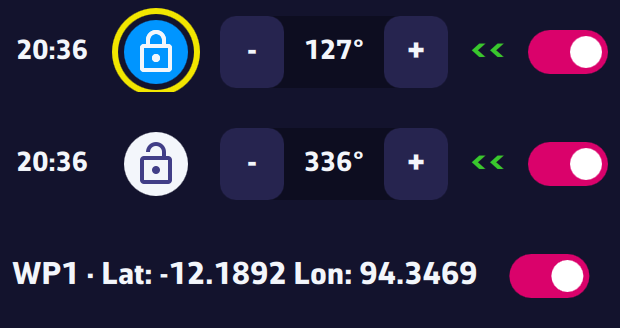 One row of each order type
Going further
The color of the angle (closed padlock). It compares your angle with the polar’s best VMG angle (VMG, velocity made good, is the speed that actually takes you upwind or downwind). Upwind: green if the angle is within half a degree of the best VMG angle; red if it is tighter than it; white if it is wider. Downwind: green within half a degree of the best angle; red if it is lower than it (deeper downwind); white otherwise.
Switching a row. Pressing the padlock turns the row from heading to TWA and back, with the matching value from the routing.
Rows that do not leave. A row whose angle is within the “Skip orders tolerance” of the previous one, on the same tack and of the same type, is skipped when sending. Rows identical to the previous one are not displayed. Beyond the race’s point limit, rows are switched off (see Programming points).
The hand-held sail plan. When the routing holds a sail on purpose, a box lists the times at which to turn the auto sails off, set the sail, then turn the auto sails back on. These stretches are also marked in orange on the timeline and flagged “by hand” in the routing table. Only stretches starting within the next 12 hours are listed.
The arrows and the side of the wind. Green arrows (starboard tack) correspond to wind received from the right; red ones (port tack) to wind received from the left. The color of the TWA in the routing table follows the same convention.