Tack and sail change penalties
BeginnerThe essentials
In VR, every tack, every gybe and every sail change slows the boat for a while and uses stamina (the skipper’s energy). The routing accounts for this: it counts the length of the penalty, the stamina taken, and the time needed to get it back. A route that strings maneuvers together is therefore not favored if it costs more than it gains.
Where to read these costs:
- the “Maneuvers” instrument gives, for “Tack”, “Gybe” and “Sail”, what the maneuver would cost now: the length of the penalty (“Time”), the miles lost at the current speed (“Loss”), the stamina taken (“Stamina”) and the time to get it back (“Back in”);
- the Stamina column of the routing table shows the energy along the route;
- the timeline marks, under the axis, the maneuvers of the orders the boat holds.
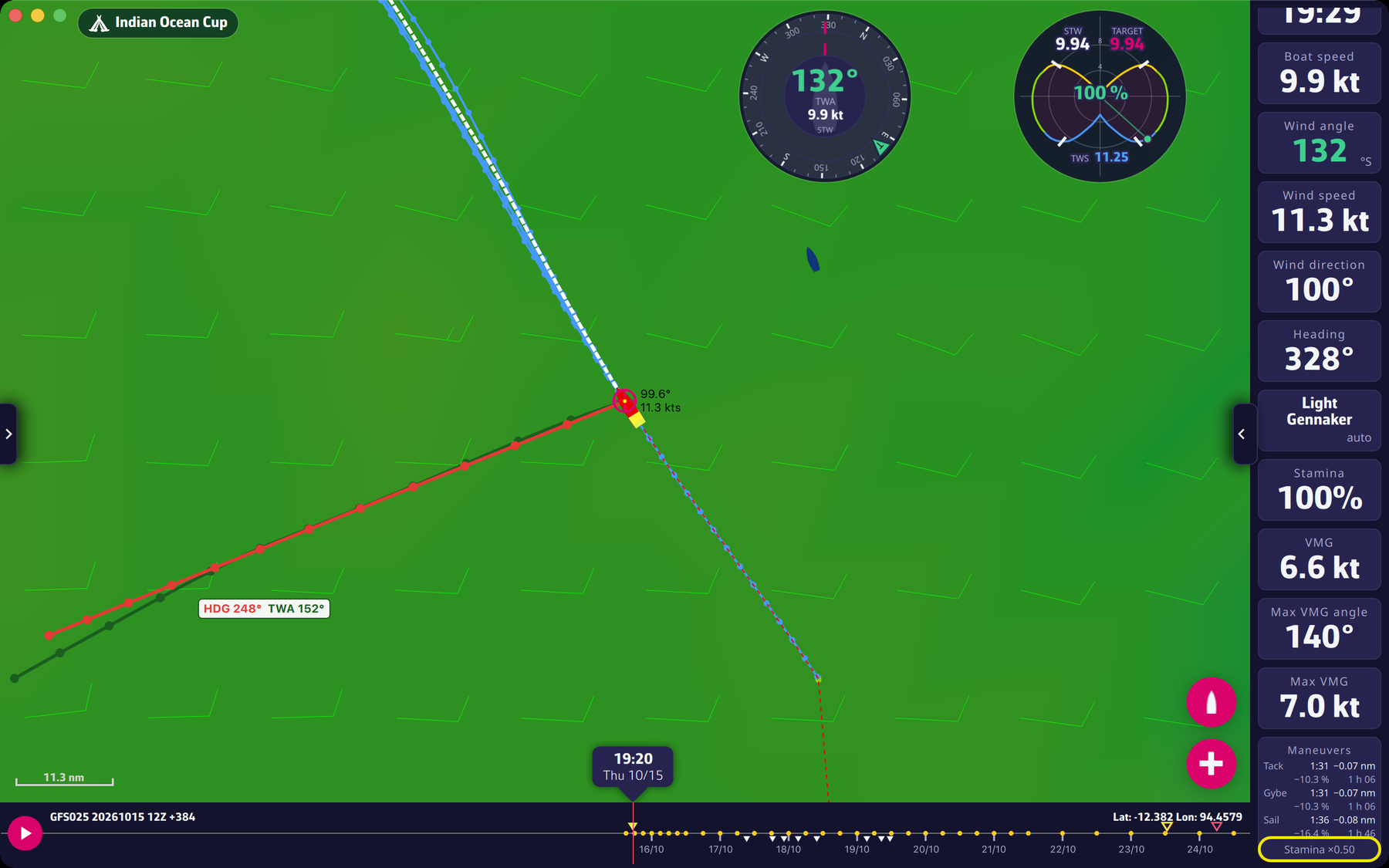 The Maneuvers instrument
Going further
What the length of a penalty depends on.
- The type of maneuver: tack, gybe or sail change.
- The wind strength: durations are given by the VR polar for a light wind and for a strong wind, and the calculation interpolates between the two.
- The boat’s equipment (standard or pro winch).
- The stamina: the duration is multiplied by a factor of 0.5 at 100% stamina and 2 at 0%. The instrument displays it as “Stamina ×…” or “Stamina factor of the durations ×…”.
Stamina. It drops with each maneuver and builds back up over time, at a pace that depends on the wind. The routing tracks it along the whole route. For the mechanism in VR in detail, see the blog article on stamina.
Sails. The automatic sail change is also a maneuver: see The boost effect for the cases where a sail is announced with an asterisk.